A Better Way to Measure the Day: The Case for Kozmos Clock and Calendar
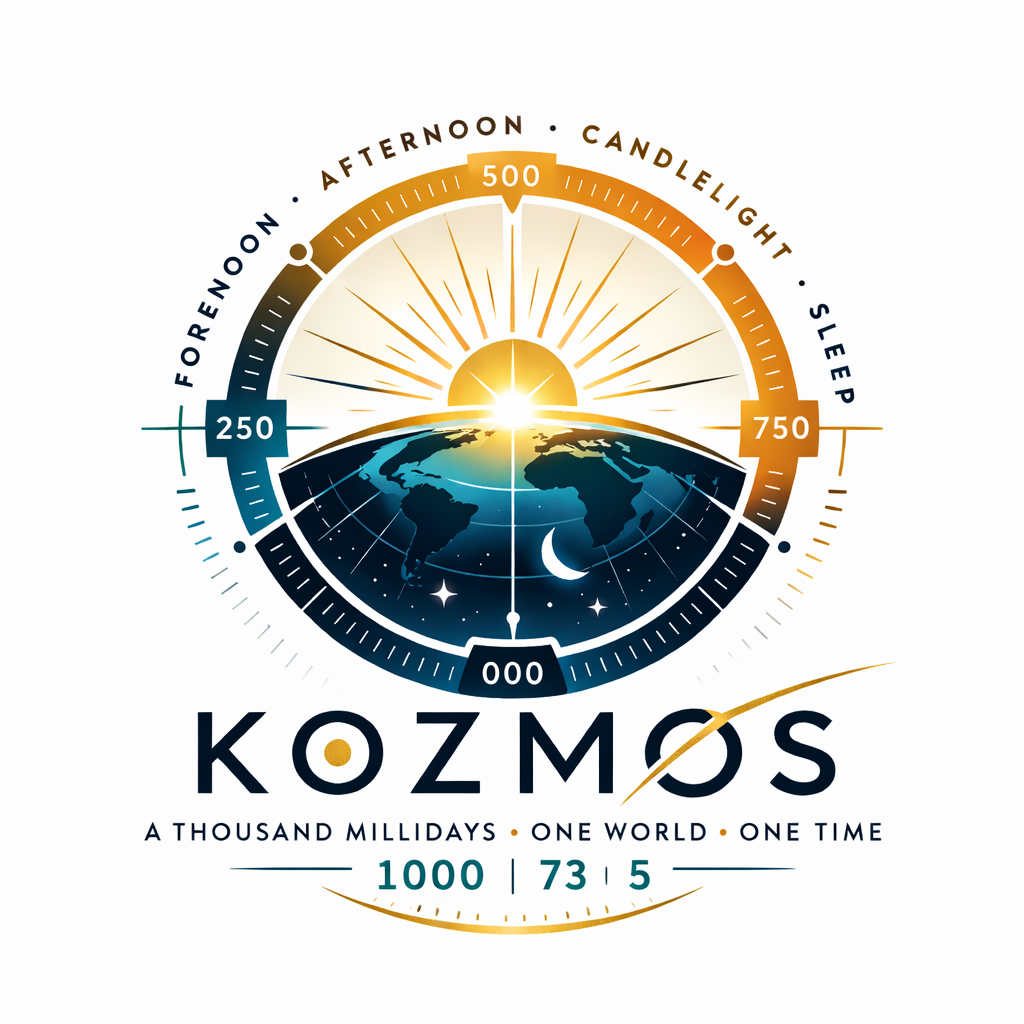
For millennia, human civilization has organized itself around two frankensteinian systems: the Gregorian calendar, a patchwork of unequal months and arbitrary divisions inherited from Roman politics and papal decree, and the traditional clock, which divides the day into two twelve-hour halves and the babylonian sexagesimal Spaghetti of the 60 minute hours and 60 second minutes. The Kozmos Clock and Calendar system offers a compelling alternative — one grounded in mathematical elegance, accuracy awareness, and a deeper respect for the unification of human actions. By rethinking how we measure both time and dates, Kozmos invites us to inhabit our days more intentionally.
The most immediate advantage of the Kozmos Clock is its radical simplicity. Rather than tracking hours, minutes, and seconds across an awkward base-60 system, the Kozmos Clock divides the day into exactly 1,000 millidays. A international business contract deadline of 656.49, Februa 60th, 2026 is the same exact time in Argentina as it is Angola. The Kozmos decimal structure makes mental arithmetic effortless and eliminates the cognitive overhead of converting between hours and fractional time. One milliday — just 86.4 seconds — becomes a natural, human-scale unit of duration, and the two-decimal precision of centimillidays offers all the granularity most people will ever need.
Beyond mere convenience, the Kozmos Clock reconnects timekeeping to the living world through its localized Solar Ring. By dividing the day into four solar periods — Forenoon (AT), Afternoon (TP), Candlelight (PF), and Sleep (CN) — based on real calculated sunrise and sunset times for your location, the clock grounds every reading in the actual position of the sun. This gives a relative sense of a solar day within the context of a unified time and calendar system; it is a daily reminder that we are biological creatures living on a rotating planet, not merely workers punching in and out of an industrial schedule.
The Kozmos Calendar brings the same clarity to the year. Where the Gregorian calendar lurches through months of 28, 29, 30, and 31 days — an artifact of Julius Caesar's astronomers and centuries of political compromise — the Kozmos Calendar divides the year into five months of exactly 73 days each: Februa, Maypril, Junly, Septogust, and Nocember. This perfect symmetric simplicity means every month is identical in length, making scheduling, planning, and anniversary-tracking far more predictable. For important world events it is important to have a universal and concrete perspective on what time it actually is. Under the current time keeping system your age actually changes based on your current timezone and dates can be mismatched by almost two full days. In the Kozmos system your age stays static and truthful.
Taken together, the Kozmos Clock and Calendar time keeping system represent more than a productivity tool — they embody a philosophy. They ask us to measure our lives in a modern standardized form rather than by bureaucratic tradition, to count our days in equal portions rather than in inherited irregularities, and to feel that time belongs to us, the organized human race. Adopting Kozmos is not about rejecting the past; it is about recognizing that the systems we inherit are choices, and that better choices are available. The day has always had 1,000 millidays in it. We simply hadn't noticed yet.
Matteo Maisano is an American industrial engineer and pharmacist who developed the Kozmos Clock and Calendar system in 2011 with a singular mission: to unite society under one simple, accurate, and universally accessible timekeeping framework. Rooted in both scientific precision and a radical simplicity, the Kozmos system reimagines how humanity measures its days — not as an exercise in disruption, but as an invitation toward clarity. The name Kozmos is derived from κόσμος, the Koiné Greek word found throughout biblical text, meaning "world" — a reflection of the system's global ambition to unite the Earth in accuracy and simplicity.